
Cosmo Strengthens its Thermal Management Business by Expanding its Lineup with “Cosmo Thermal Fluid,” an Immersion Cooling Fluid for Data Centers
January 27, 2026
Cosmo Energy Holdings Co., Ltd.
Cosmo Oil Lubricants Co., Ltd.
Cosmo Oil Lubricants Co., Ltd. (hereafter, “the Company”), a subsidiary of Cosmo Energy Holdings Co., Ltd., is pleased to announce the addition of “Cosmo Thermal Fluid,” a high-performance immersion cooling fluid¹ for data centers, to its “Cosmo Thermal” series lineup.
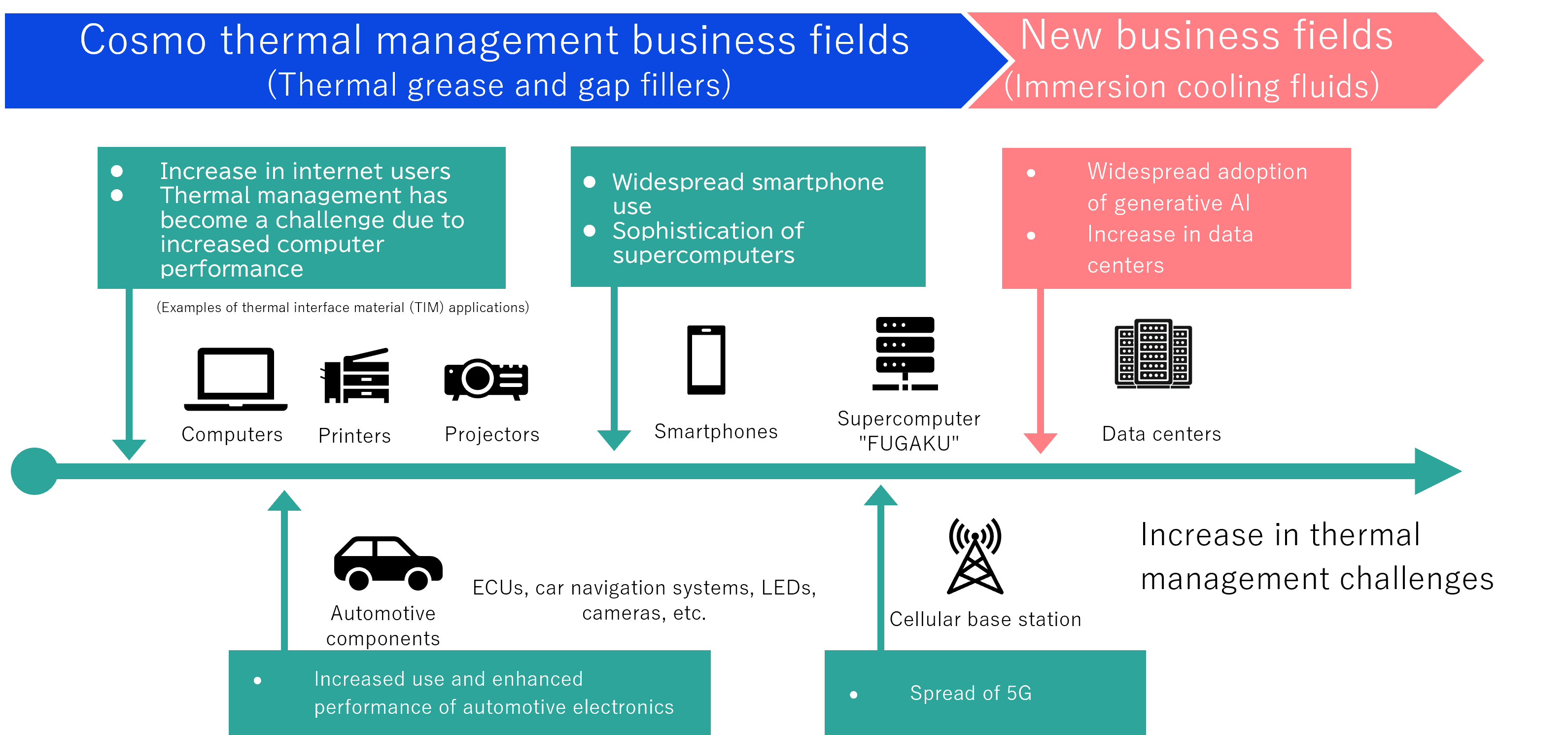
In recent years, with the rapid adoption of generative AI driving growth in the number of data centers and increased heat output from higher performance servers, greater energy efficiency in data center cooling has become a critical societal challenge. Immersion cooling is gaining attention as a highly efficient cooling technology, and “Cosmo Thermal Fluid,” with its outstanding performance as an immersion cooling fluid, contributes significantly to improving data center energy efficiency. The Company plans to gradually expand its lineup of immersion cooling fluids to meet diverse needs, including high-flash-point products (flash point ≥250°C) that comply with Japan’s Fire Service Act and low-viscosity products that enable highly efficient cooling.
For many years, the Company has been addressing thermal management challenges in various industries, including electronics and automotive fields, with a focus on thermal interface materials such as thermal grease² and thermal gap fillers³.
Going forward, the Company remains committed to making the most of the technologies and expertise it has developed to date and to strengthening its thermal management business, aiming to provide integrated thermal management solutions.
Overview of Cosmo's Thermal Management Business Fields
- What is immersion cooling?
Immersion cooling is a method in which servers—including electronic components such as CPUs, GPUs, and memory—are cooled by directly submerging them in a specialized non-conductive dielectric liquid. In conventional data centers, air cooling has been the norm, relying on fans to circulate heat and indoor air-conditioning systems to dissipate it. In contrast, immersion cooling can handle heat more efficiently because the dielectric liquid directly absorbs it. - What is thermal grease?
Thermal grease is a thermal interface material (TIM) used to dissipate heat generated within electronics. It is primarily applied at interfaces where heat transfer is required—such as between heat-generating components like CPUs, GPUs, and power semiconductors, and heat sinks (heat-dissipation plates) or cooling systems—to improve heat transfer efficiency. Because thermal grease has a paste-like consistency, it conforms to surface irregularities, enabling more effective heat transfer and dissipation. - What are thermal gap fillers?
Like thermal grease, thermal gap fillers are thermal interface materials (TIMs) used in electronics. As with grease, they are initially applied in a paste-like form, allowing them to fill gaps between components. Over time or with temperature changes, they cure and harden. Because they solidify while retaining their applied shape, thermal gap fillers are less likely to be squeezed out or displaced by vibration or thermal cycling.
(End)
(The official language for Cosmo Energy Group's filings with the Tokyo Stock Exchange and Japanese authorities, and for communications with our shareholders, is Japanese. We have posted English versions of some of this information on this website. While these English versions have been prepared in good faith, Cosmo Energy Group does not accept responsibility for the accuracy of the translations, and reference should be made to the original Japanese language materials.)