
Cosmo Oil Marketing and Partners Conclude Agreement with Shimonoseki City to Promote the Recycling of Used Cooking Oil into SAF and Other Products ~Collecting Household and Commercial Used Cooking Oil at Municipal Facilities for Use in Domestic SAF Production~
February 9, 2026
Cosmo Energy Holdings Co., Ltd.
Cosmo Oil Marketing Co., Ltd.
Shimonoseki City
JGC HOLDINGS CORPORATION
REVO International Inc.
SAFFAIRE SKY ENERGY LLC
Cosmo Oil Marketing Co., Ltd. (“Cosmo Oil Marketing”), a subsidiary of Cosmo Energy Holdings Co., Ltd., JGC HOLDINGS CORPORATION (“JGC HD”), REVO International Inc. (“REVO International”), and SAFFAIRE SKY ENERGY LLC (“SAFFAIRE SKY ENERGY”) entered into a partnership agreement with the City of Shimonoseki, Yamaguchi Prefecture, on February 6, 2026, to promote the adoption of Sustainable Aviation Fuel (SAF) produced from used cooking oil (“the Agreement”). On the same day, a signing ceremony was held at Shimonoseki City Hall, marking the first step toward a new resource recycling model that brings together Shimonoseki’s local community and businesses.
In addition to concluding the Agreement, the City of Shimonoseki joined the “Fry to Fly Project,” an initiative aimed at realizing a world where aircraft are powered by SAF. The City will work to recycle used cooking oil collected from households and other sources into SAF. In addition, it plans to collect used household cooking oil from citizens at the “Cosmo Earth Conscious Act Clean Campaign” event, scheduled to take place in Shimonoseki on March 14.
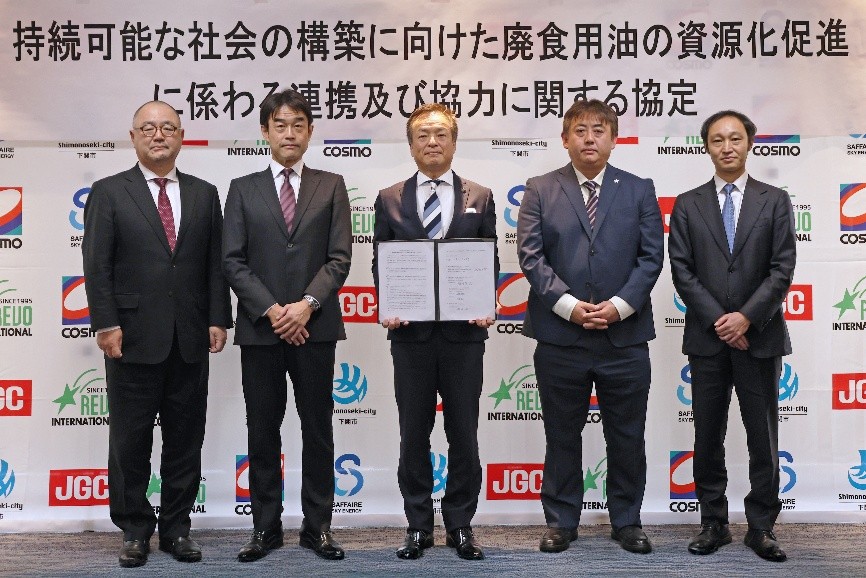
At the signing ceremony (from left: Masahiro Aika, Executive Vice President of JGC HD; Tadashi Okada, Director and Senior Executive Officer of Cosmo Oil Marketing; Shintaro Maeda, Mayor of Shimonoseki City; Hiroaki Kuriyama, Deputy General Manager of the Carbon Resource Circulation Promotion Department at REVO International; Yuki Nishimura, Chief Operating Officer (COO) of SAFFAIRE SKY ENERGY)
▪️Background and Purpose
Shimonoseki City has been designated a "Decarbonization Leading Area" by Japan’s Ministry of the Environment and aims to achieve both regional economic revitalization and decarbonization. Focusing on urban districts where tourist facilities, such as Karato Market, and tertiary sector businesses are concentrated, the City is promoting capital investment through its Environmentally Responsible Business Operator Certification Program along with preferential interest loans offered by local financial institutions. In addition, the City is focusing on environmental education and outreach to foster citizen engagement in decarbonization efforts.
Against this backdrop, under the Agreement the City of Shimonoseki will recycle used cooking oil into domestic SAF feedstock through a program that encourages participation from both citizens and businesses. Furthermore, Cosmo Oil Marketing—which jointly proposed Shimonoseki’s designation as a Decarbonization Leading Area—will closely collaborate with the other parties to the Agreement to proactively promote the formation of a sustainable, circular economy and realization of a decarbonized society.
▪️Key Points Covered in the Agreement
- Matters pertaining to the collection of used cooking oil
- Activities necessary for the continuous production and supply of used cooking oil-derived SAF and other fuels
- Matters related to providing opportunities for broad information dissemination to citizens and others regarding the recycling of used cooking oil into SAF, as well as activities to raise public awareness around this topic
- Activities required to increase the number of new collection points within Shimonoseki City
- Other efforts necessary to fulfill the objectives of the Agreement
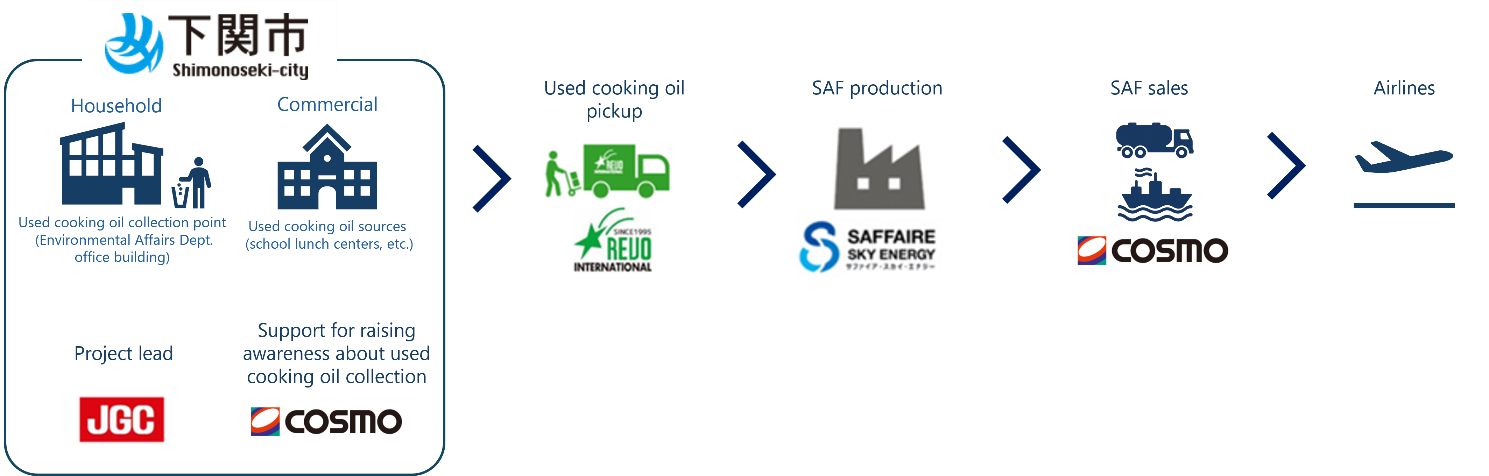
Conceptual diagram of the supply chain based on the Agreement
▪️Specific Initiatives
Based on the Agreement, a used household cooking oil collection point has been installed at the Shimonoseki City Environmental Affairs Department building; collection from citizens began on February 6. In addition, preparations are underway to utilize used commercial cooking oil from public facilities in Shimonoseki City—such as municipal elementary and junior high school lunch centers—for SAF production starting in April 2026.
Used cooking oil collected from households at public facilities, as well as oil used by the facilities themselves, will be picked up and transported by REVO International to the SAFFAIRE SKY ENERGY plant, located on the premises of Cosmo Oil Co., Ltd.’s Sakai Refinery. The plant is Japan’s first facility for the large-scale production of SAF, where the oil will be repurposed into domestic SAF feedstock. The SAF produced at the plant will be supplied to domestic and overseas airlines via the Cosmo Energy Group. Under the Agreement, the City of Shimonoseki expects to provide approximately 12,000 kilograms of used cooking oil annually as SAF feedstock.
Going forward, the City will consider the further expansion of used household cooking oil collection points and will promote regional resource recycling through outreach activities targeting citizens and private businesses throughout the city. These initiatives constitute an accessible, grassroots effort that provides an opportunity for individuals to contribute to decarbonization. The City of Shimonoseki will work together with citizens and businesses to advance used oil collection to fulfill its commitment as a designated Decarbonization Leading Area and its “Zero-Carbon City Shimonoseki” declaration to achieve net zero greenhouse gas emissions by 2050.
▪️About Decarbonization Leading Areas
Decarbonization Leading Areas aim to achieve net zero CO2 emissions from electricity consumption in the residential sector (households, businesses, and other sectors) by 2030 through the implementation of pioneering decarbonization initiatives according to regional characteristics, etc. These areas serve as models for spreading decarbonization initiatives to other regions throughout Japan.
▪️Efforts Undertaken by Cosmo Oil Marketing and the City of Shimonoseki
In response to the Ministry of the Environment’s call for the fifth round of applications to select Decarbonization Leading Areas, Cosmo Oil Marketing submitted a joint proposal in support of Shimonoseki City’s designation.
Press release issued on October 16, 2024
Joint Proposal by Cosmo Oil Marketing on Designating Shimonoseki City as a Decarbonization Leading Area Selected by Japan’s Ministry of the Environment
URL: https://www.cosmo-energy.co.jp/en/information/press/2024/241016-01.html
▪️Overview of the Project for Large-scale Production of Japan’s First Domestic SAF
Cosmo Oil, JGC HD, and REVO International have jointly pursued the commercialization of a domestic SAF supply chain—encompassing everything from the collection of used cooking oil to the production, transportation, and supply of SAF. As part of this effort, the three parties established a new company, SAFFAIRE SKY ENERGY, in 2022. The SAFFAIRE SKY ENERGY SAF production plant was completed in December 2024 on the premises of Cosmo Oil's Sakai Refinery (Sakai City, Osaka Prefecture), and began supplying domestic SAF to major airlines around April 2025. The supplied SAF has obtained ISCC CORSIA certification, which recognizes compliance with international standards for sustainable products.
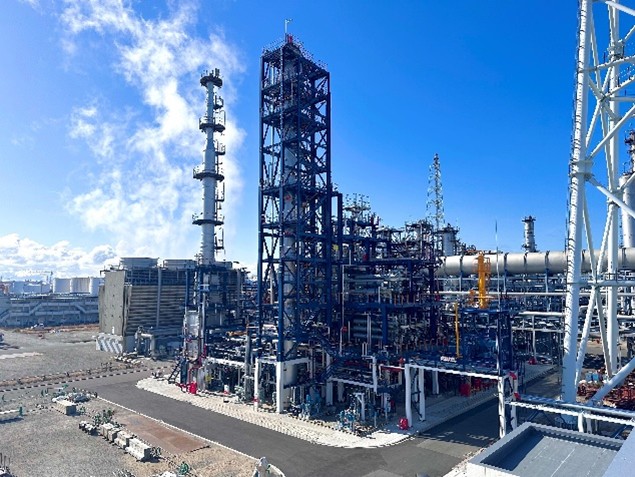
Completed SAF production plant
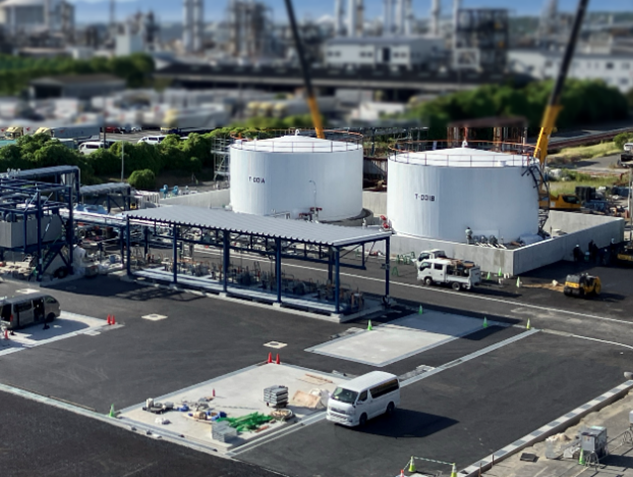
Facility for receiving used cooking oil as SAF feedstock
(End)
(The official language for Cosmo Energy Group's filings with the Tokyo Stock Exchange and Japanese authorities, and for communications with our shareholders, is Japanese. We have posted English versions of some of this information on this website. While these English versions have been prepared in good faith, Cosmo Energy Group does not accept responsibility for the accuracy of the translations, and reference should be made to the original Japanese language materials.)