
Cosmo Oil and Partners Commence Bench-Scale Testing for the Production of CO2-Derived Solid Carbon Using Molten Salt Electrolysis Technology ~Establishing a New Five-Party Industry-Academia Framework~
May 22, 2026
Cosmo Energy Holdings Co., Ltd.
Cosmo Oil Co., Ltd.
National University Corporation Kyoto University
I’MSEP Co., LTD.
Sumitomo Heavy Industries, Ltd.
SEC CARBON, LIMITED
Cosmo Oil Co., Ltd. (hereafter, “Cosmo Oil”), a subsidiary of Cosmo Energy Holdings Co., Ltd., together with National University Corporation Kyoto University (hereafter “Kyoto University”), I'MSEP Co., LTD. (hereafter, “I'MSEP”), Sumitomo Heavy Industries, Ltd. (hereafter, “SHI”), and SEC CARBON, LIMITED (hereafter, “SEC CARBON”), are pleased to announce the commencement of joint bench-scale testing for the production of CO2-derived solid carbon using molten salt electrolysis technology (hereafter, the “Initiative”).
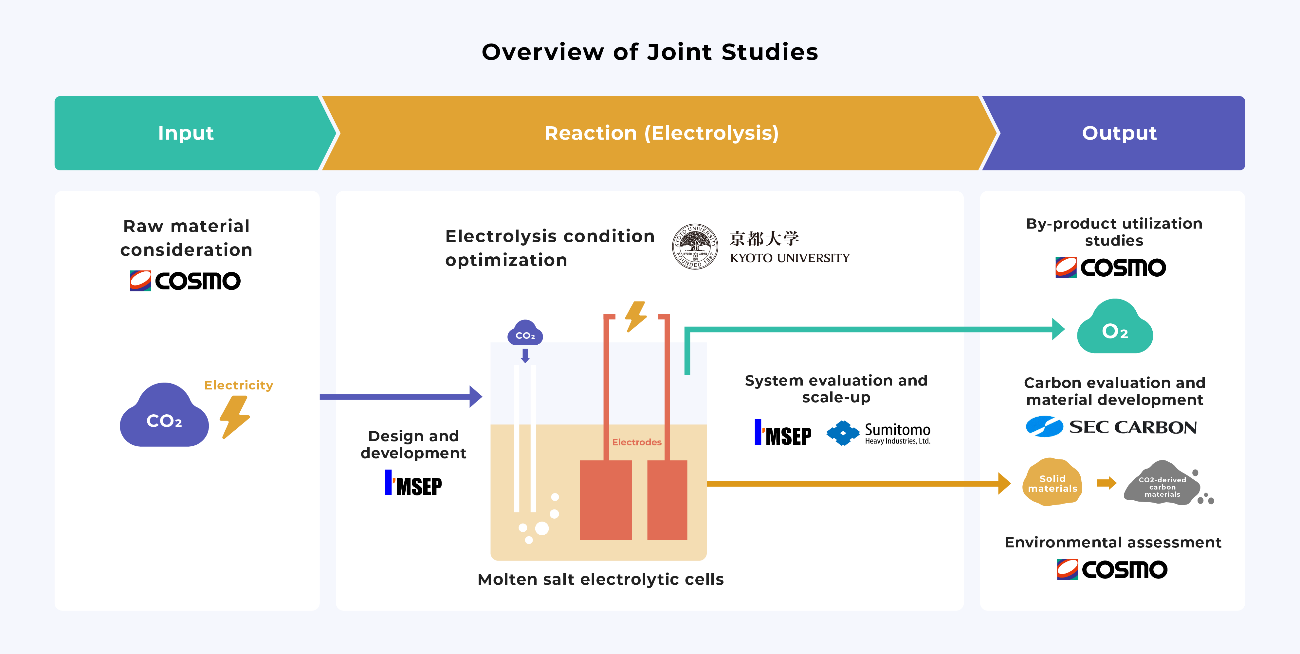
Building on the results of joint studies1, 2 conducted by the Cosmo Energy Group, Kyoto University, and I'MSEP to date, the Initiative represents the next step in verifying technical feasibility from an end-to-end supply chain perspective, encompassing everything from CO2 supply and equipment development to evaluation as a carbon material and consideration of potential applications.
These latest joint studies include participation from SHI and SEC CARBON. SHI has extensive experience in integrated services for energy plants and chemical process equipment, ranging from design, construction, operation, and evaluation to maintenance, while SEC CARBON possesses longstanding expertise in the manufacture and evaluation of carbon materials used in electrolysis and high-temperature processes, including artificial graphite electrodes and cathode blocks for aluminum smelting.
Through bench-scale verification of carbon production at an annual scale of several tens of kilograms, the parties will examine the feasibility of applying a technology that converts CO2 into solid carbon from both process and materials perspectives.
■ Initiative Background
Carbon dioxide capture and utilization (CCU) is regarded as an important technological field for realizing a carbon-neutral society, and growing attention is being paid to technologies to ensure the long-term fixation and utilization of CO2 as stable solid carbon. Among these, molten salt electrolysis technology enables the conversion of CO2 into carbon materials using only electrical energy and, unlike other CCU technologies such as e-fuels, does not require clean hydrogen, which can be costly. When combined with renewable energy, the technology is expected to serve as a low-carbon, environmentally friendly solution in the future.
Moreover, carbon materials such as graphite and carbon nanomaterials are indispensable to a wide range of industries, including storage batteries and next-generation energy sectors. At the same time, concerns have been raised globally regarding dependence on a limited number of supply sources and the associated geopolitical risks. The production of carbon materials from CO2 therefore has the potential not only to contribute to decarbonization, but also to help diversify and stabilize Japan’s carbon material supply chains.
■ Initiative Overview
Under the Initiative, the parties will advance joint studies in the following areas using a bench- scale testing system.
・Verification of the technical feasibility of producing CO2-derived carbon materials using molten salt electrolysis technology
・Examination of the entire supply chain, from raw material procurement to production and utilization
・Identification of challenges and key considerations with an eye toward future real-world deployment
Going forward, the five parties will continue their joint studies in collaboration with relevant companies, while taking into account factors such as domestic and global technology and policy trends, as well as the business environment surrounding the materials and energy sectors. Through these efforts, the parties aim to contribute both to the realization of a decarbonized society and the creation of new value.
■ Initiatives Undertaken by Each Company
About the Cosmo Energy Group
The Cosmo Energy Group is accelerating its decarbonization-related initiatives under Vision 2030, which outlines its medium- to long-term goals, to achieve net zero carbon emissions by 2050. The Initiative is one of the Group’s measures to “strengthen competitiveness of the Oil Business and pursue low carbonization,” as set forth in Vision 2030. As the first step toward the future real-world deployment and commercialization, the Group will continue contributing to the realization of a sustainable society from both energy and materials perspectives.
About Kyoto University
Kyoto University will lead the academic validation of the molten salt electrolysis technology at the core of the Initiative, drawing on the expertise in molten salt chemistry and electrochemistry it has cultivated over many years, together with its cutting-edge research achievements. By further advancing the joint studies conducted to date and actively promoting industry-academia collaboration that bridges basic research and real-world deployment, the University will help establish innovative CCU technologies and realize a carbon-neutral society.
About I'MSEP
I'MSEP is actively engaged in business activities to help facilitate a paradigm shift toward a more sustainable society, leveraging the technological potential of molten salt electrolysis. In particular, it has positioned the Initiative as a vital step toward the commercialization of proprietary technologies that contribute to carbon neutrality. I'MSEP will play a central role in creating new industries through the real-world deployment of molten salt technologies to become a uniquely positioned company in both domestic and global markets.
About Sumitomo Heavy Industries
The SHI Group is working to mitigate its environmental impact by reducing the environmental footprint of its business activities and improving the environmental performance of its products, guided by its purpose to “Enhance society and those within it with compassion through our ownership and vision.” The Initiative is being led by the Technology Research Center, which oversees the group’s research and development, as part of activities aimed at building a technological foundation for future carbon recycling. Drawing on its expertise as a comprehensive machinery manufacturer, SHI will advance technological development through the Initiative and contribute to the realization of a sustainable society.
About SEC CARBON
Under the Initiative, SEC CARBON will participate in the evaluation of CO2-derived carbon and the study of its potential material applications, leveraging the expertise it has built up through the manufacture and evaluation of carbon materials, including artificial graphite electrodes and cathode blocks for aluminum smelting. As a carbon materials manufacturer, the company aims to achieve both decarbonization and the creation of added value through efforts to reduce CO2 emissions and bring out the value of CO2-derived carbon as a material. The Initiative will also contribute to “the development and launch of products that help achieve carbon neutrality,” one of the company's material sustainability issues, through the promotion of CO2 utilization technologies, a focus area of its medium- to long-term management policy, “2030 Make Real.”
- Press release issued on March 20, 2023 (available in Japanese only):
Cosmo Oil and Kyoto University Sign a Comprehensive Partnership Agreement Concerning Potential Joint Development of Technologies for the Stable Supply of Next-Generation Energy, etc.
https://www.cosmo-energy.co.jp/ja/information/press/2023/230320.html - Press release issued on January 29, 2024 (available in Japanese only):
Cosmo Oil and I’MSEP Sign a Basic Agreement to Jointly Explore Converting CO2 into a Valuable Product (CCU) Using Molten Salt Electrolysis Technology
https://www.cosmo-energy.co.jp/ja/information/press/2024/240129-01.html
(End)
(The official language for Cosmo Energy Group's filings with the Tokyo Stock Exchange and Japanese authorities, and for communications with our shareholders, is Japanese. We have posted English versions of some of this information on this website. While these English versions have been prepared in good faith, Cosmo Energy Group does not accept responsibility for the accuracy of the translations, and reference should be made to the original Japanese language materials.)