
Cosmo and Nihon University to Jointly Explore the Development of Bio-Isobutanol Using Non-Food-Competing Feedstocks ~Aiming to Establish an Efficient Process for Producing Second-Generation Alcohol from Sugars~
March 16, 2026
Cosmo Energy Holdings Co., Ltd.
College of Industrial Technology, Nihon University
Cosmo Energy Holdings Co., Ltd. (hereafter, “Cosmo Energy Holdings”) and the College of Industrial Technology, Nihon University concluded an agreement on March 16, 2026, regarding a joint study to explore technologies for producing bio-isobutanol from non-food-competing, non-edible biomass-derived feedstocks.
In order to realize a carbon-neutral society, fuel production technologies that utilize such feedstocks are becoming increasingly important. In particular, there are calls for liquid fuels and chemicals that are highly compatible with existing petroleum products to be decarbonized via a shift to renewable feedstocks, such as those derived from biomass.
Against this backdrop, bio-isobutanol¹ is gaining attention as a second-generation alcohol with applications in both the fuel and chemicals sectors. In addition to its direct use as a diesel fuel alternative, it can be converted into materials that serve as feedstocks for gasoline, sustainable aviation fuel (SAF), and various chemicals. However, unlike with ethanol, no naturally occurring microorganisms can efficiently produce isobutanol. This presents a challenge in that the development of advanced biotechnologies is essential for its practical application.
◼︎Conceptual Diagram of the Joint Study
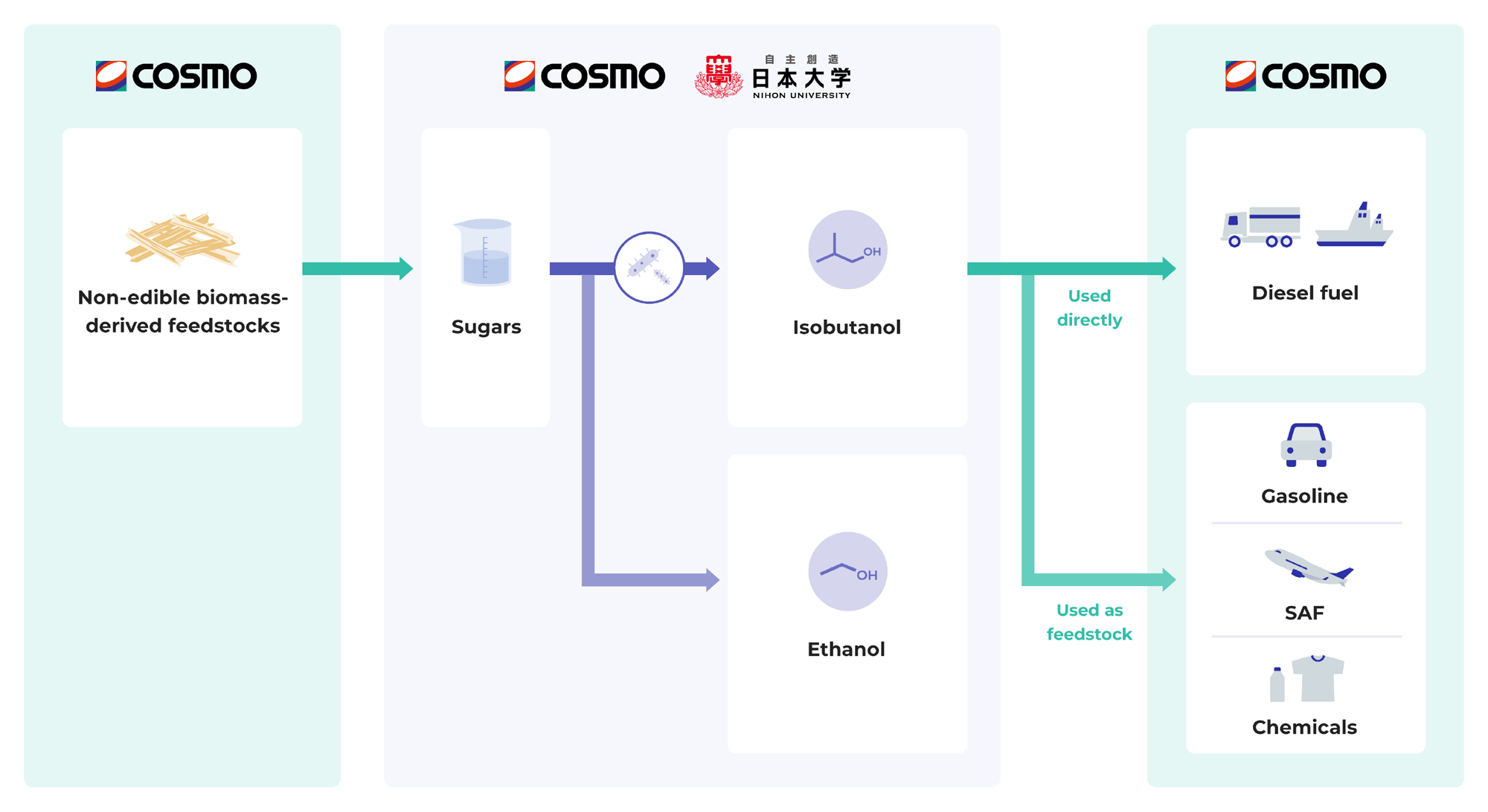
In this joint study, the two parties will leverage the College of Industrial Technology, Nihon University’s microbial genetic engineering technology and advanced expertise in developing isobutanol-producing strains from sugars to create production strains capable of efficiently producing bio-isobutanol from non-edible sugar-based feedstocks. The study also aims to establish saccharification and fermentation processes that can be applied to bioethanol production.
This initiative is a new technology development project exploring the potential of applying sugar-derived isobutanol in the production of various fuels and chemicals. It will help strengthen technological platforms for the advanced utilization of non-edible biomass-derived feedstocks, a key focus of Cosmo Energy Holdings. Looking ahead, the Company aims to support the realization of a carbon-neutral society by applying this technology in the production of a wide range of products, including diesel fuel alternatives, gasoline, SAF, and chemicals.
The establishment of this technology is expected to create new options in the fuel and chemicals sectors by enabling the use of sugar resources, which until now have been primarily limited to ethanol production. In addition, its application will help support biofuel production by making effective use of waste materials, including lignocellulosic feedstocks such as bagasse and pulp, as well as other waste-derived feedstocks.
Through this joint study, Cosmo Energy Holdings and the College of Industrial Technology, Nihon University are committed to enhancing the added value of non-edible biomass-derived feedstocks and promoting resource recycling, while contributing to greater energy security by expanding the supply of domestically produced energy.
▪️About the Cosmo Energy Group
The Cosmo Energy Group has declared its commitment to achieving net zero carbon emissions by 2050 and is accelerating its decarbonization initiatives through Vision 2030 and The Seventh Consolidated Medium-Term Management Plan, Oil & New ~Next Stage~. This joint study is a concrete measure that contributes to “strengthening competitiveness of the Oil Business and pursuing low carbonization” and “expanding next-generation energy,” as set forth in Vision 2030. In line with the Group Management Vision of “Striving for an infinite tomorrow, developing sustainably in harmony with humanity, society, and our planet,” the Group is dedicated to addressing societal challenges and achieving sustainable corporate development.
▪️About the College of Industrial Technology, Nihon University
The College of Industrial Technology, Nihon University established the Industrial Technology Institute to investigate, research, and provide guidance across the field of industrial engineering, and contribute to the advancement and exchange of associated scientific knowledge. In addition, with the Research and Technology Exchange Center serving as a point of contact, the College promotes collaboration with industry and government by leveraging its abundant human resources and intellectual property, and engages in initiatives that contribute to society.
- Isobutanol: A type of alcohol (chemical formula C₄H₉OH). In addition to being used as a solvent and chemical feedstock, it has attracted attention as a next-generation fuel in recent years.
(End)
(The official language for Cosmo Energy Group's filings with the Tokyo Stock Exchange and Japanese authorities, and for communications with our shareholders, is Japanese. We have posted English versions of some of this information on this website. While these English versions have been prepared in good faith, Cosmo Energy Group does not accept responsibility for the accuracy of the translations, and reference should be made to the original Japanese language materials.)