
- ICAO: International Civil Aviation Organization
- Alcohol-to-Jet (ATJ) technology: A technique to convert alcohol (ethanol) into SAF through a series of catalytic reactions
Commence SAF Production
Pioneering the mass production of domestic SAF in Japan
Starting in FY2025, the Cosmo Energy Group commenced large-scale production of Japan’s first Sustainable Aviation Fuel (SAF) at Cosmo Oil’s Sakai Refinery.
At the 2016 session of the ICAO1 Assembly, the aviation industry set the goal of carbon-neutral growth from 2020, whereby CO2 emissions from international aviation would not exceed 2019 levels. In 2022, the Assembly further adopted the long-term aspirational goal of achieving net zero carbon emissions by 2050. The use of SAF is regarded as the most promising pathway to achieving these goals. In Japan, the oil industry is expected to supply sufficient SAF to achieve a 5% reduction in greenhouse gas (GHG) emissions by 2030. Since meeting this target requires replacing approximately 10% of aviation fuel with SAF, the public and private sectors are currently working together to promote its widespread adoption.
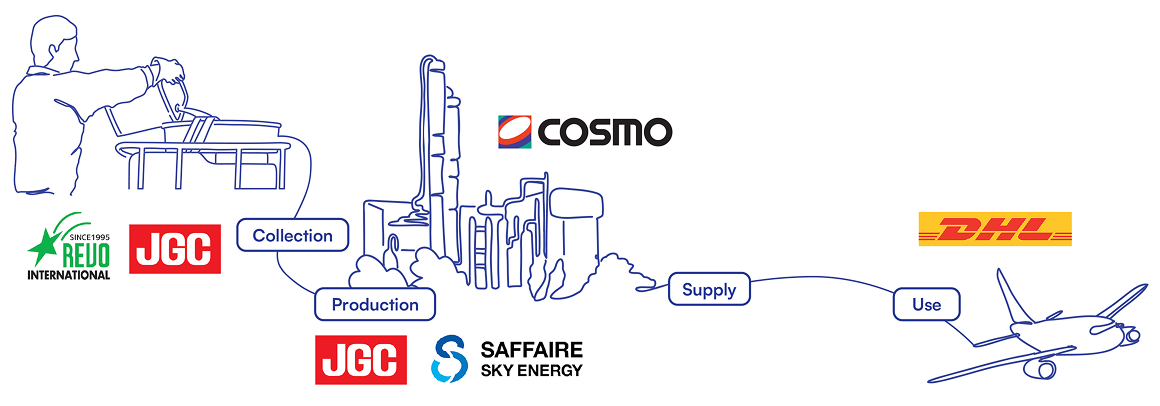
In 2021, the Group, together with JGC HOLDINGS CORPORATION and REVO International Inc., submitted a joint proposal for an open call project to the New Energy and Industrial Technology Development Organization (NEDO) titled "Establishment of a Supply Chain Model for Bio-jet Fuel Production from Domestic Used Cooking Oil," which was subsequently adopted. Building on this milestone, the Group became an industry pioneer in advancing domestic SAF supply, and in April 2025 began supplying Japan’s first mass-produced domestic SAF. By bringing together the expertise and assets cultivated over many years across our respective businesses, we successfully established an end-to-end supply chain covering everything from feedstock procurement to SAF production and its supply to airlines. Looking ahead, we will accelerate efforts to establish a domestic SAF supply chain while diversifying feedstocks and production processes, including exploring bio-ethanol-derived SAF production using Alcohol-to-Jet (ATJ) technology.2
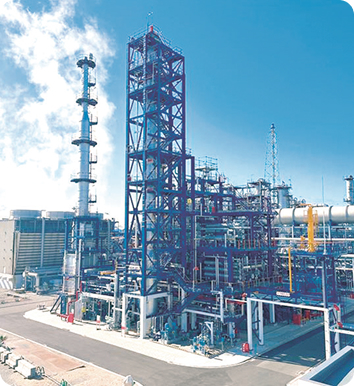
SAF production unit
(on the premises of Cosmo Oil’s Sakai Refinery)
History of the SAF business

- ISCC CORSIA certification: Issued by the ISCC based on the Carbon Offsetting and Reduction Scheme for International Aviation (CORSIA). To claim GHG reduction effects through the use of SAF, certification under a sustainability certification scheme (SCS) recognized by the International Civil Aviation Organization (ICAO) for the certification of CORSIA Eligible Fuels (CEF) is required.
- ISCC EU certification: Issued by the ISCC to demonstrate compliance with the sustainability criteria set out in the European Union (EU)’s Renewable Energy Directive II (RED II)
Establishing a Domestic SAF Supply Chain
The Cosmo Energy Group, together with JGC HOLDINGS CORPORATION and REVO International Inc., has taken a pioneering role within the oil industry in establishing a domestic SAF supply chain leveraging the respective strengths of each company. By becoming the first in Japan to start mass producing domestic SAF in April 2025 and having our customers use it, we are also contributing to reducing CO2 emissions. Going forward, we will continue to promote the use of SAF in air transportation and contribute to the creation of a sustainable, resource-recycling society.
Information on this page is as of October 2025, the publication date of the Cosmo Report 2025.
General Manager, Carbon Circularity Business Division
REVO International Inc.
Amid growing global demand for SAF, I believe we were able to achieve the country’s first commercial-scale SAF supply by leveraging the strengths of our three companies. This enabled us to build momentum for the stable procurement of used cooking oil as feedstock, with the aim of ensuring a stable supply of Japan’s first domestically produced SAF.
Since our founding, REVO International has independently established a used cooking oil procurement network to support the domestic adoption and expansion of biofuel production technologies.
At present, we source this feedstock from around 38,000 establishments nationwide, including restaurants, commercial facilities, and food factories. Going forward, as maximizing area-based collection efficiency becomes increasingly important to reduce costs and ensure efficient, stable procurement, we will leverage cutting-edge digital technologies to streamline procurement from these sources, thereby reducing costs and increasing procurement volume.
Program Manager, Sustainability Co-Creation Unit, JGC Holdings Corporation
Chief Operating Officer, SAFFAIRE SKY ENERGY LLC
When we first approached Cosmo Oil in July 2020 regarding the joint production of domestic SAF, we never imagined that this project would have such a significant impact in today’s world.
As we explored the business’s commercial viability, the strongest factor behind us successfully establishing Japan’s first SAF supply chain was the solid trust we built with our counterparts at Cosmo Oil and REVO International, enabling us to openly share our intentions and ideas with one another.
Through our unique initiatives, such as "ACT FOR SKY" and the "Fry to Fly Project," we are committed to enhancing the value of domestically produced SAF and driving further growth of the business.
Director, Commercial Planning & Research Commercial
DHL Japan, Inc.
DHL has been an industry pioneer in offering its global GoGreen Plus service, which returns the environmental value of SAF to shippers. Through Cosmo Oil Marketing, we were able to receive Japan’s first domestically produced SAF at Chubu Centrair International Airport, representing a significant milestone for our operations in the Japanese market.
This achievement has allowed DHL Japan to join a public-private initiative aimed at raising awareness of domestic SAF and to showcase our efforts utilizing it, as well as our collaboration with Cosmo Oil Marketing, to the market.
This is precisely the type of impact that comes from being a first mover, and it reflects the foresight and decisiveness of the Cosmo Energy Group within Japan’s oil industry. Looking ahead, I believe that the Group, through its SAF production and sales operations, along with the rollout of SAF-based services for shippers, will further strengthen our partnership and enable us to reduce environmental impact.