Material Issue KPIs and Identification Process

The Cosmo Energy Group has established material issues as the priority challenges to be addressed in pursuing the Group’s future growth and fulfilling its vision.

In fiscal 2025, as part of the process of developing our new Eighth Consolidated Medium-Term Management Plan, which will launch in fiscal 2026, we reassessed our material issues in light of the increasing complexity of social challenges and changes in the business environment. Focusing on aligning our business strategy with social demands, including stakeholder expectations, we revised our material issues into six priority issues to highlight the key challenges for achieving sustainable value creation and enhancing enterprise value over the medium and long term.

Vision for Addressing Material Issues

Risks and Opportunities, Key KPIs, and Contributing SDGs of Materiality

Material issues Vision Risks and Opportunities Major KPIs Related SDGs
Safe operations and stable supply
  • A state in which injuries to employees and others, as well as plant and product accidents, are prevented, and operations do not threaten the safety or environment of surrounding communities
  • A state in which we are fulfilling our social responsibility by safeguarding people's lives and livelihoods through stable supply

Risks

  • Loss of revenue and trust due to supply disruptions caused by serious accidents or natural disasters
  • Number of serious accidents
  • Implementation of BCP drills
3 GOOD HEALTH AND WELL-BEING 7 AFFORDABLE AND CLEAN ENERGY 9 INDUSTRY, INNOVATION AND INFRASTRUCTURE 11 SUSTAINABLE CITIES AND COMMUNITIES 12 RESPONSIBLE CONSUMPTION AND PRODUCTION 14 LIFE BELOW WATER

Opportunities

  • Maintaining high utilization rates and earning trust through safe operations and stable supply
  • Higher productivity through the use of digital technologies
Contributing to a carbon-neutral society
  • A state in which we are making progress toward achieving net-zero carbon emissions by 2050
  • A state in which we are developing and providing clean energy that meets the needs of our customers

Risks

  • Higher costs from carbon taxes
  • Loss of revenue opportunities as competitors expand their regional decarbonization businesses
  • Avoided GHG emissions
  • GHG emission reduction rate
  • Carbon intensity (CI) reduction rate
7 AFFORDABLE AND CLEAN ENERGY 9 INDUSTRY, INNOVATION AND INFRASTRUCTURE 12 RESPONSIBLE CONSUMPTION AND PRODUCTION 13 CLIMATE ACTION 14 LIFE BELOW WATER 17 PARTNERSHIPS FOR THE GOALS

Opportunities

  • Developing businesses that meet customers’ decarbonization needs
  • Responding to decarbonization expectations from financial markets
  • Expanding regional decarbonization businesses
Sustainable growth strategy
  • A state in which we are achieving sustained profit growth by adapting to changes in the business environment through investments in growth businesses and other initiatives, supported by stable earnings from existing operations

Risks

  • Loss of revenue opportunities due to delays in strategic investment in future growth areas
  • Power generation capacity (renewable energy) growth rate
  • NeXT Growth business growth rate
  • Strategic investment allocation
7 AFFORDABLE AND CLEAN ENERGY 8 DECENT WORK AND ECONOMIC GROWTH 9 INDUSTRY, INNOVATION AND INFRASTRUCTURE 12 RESPONSIBLE CONSUMPTION AND PRODUCTION

Opportunities

  • Achieving profitability in and scaling growth businesses driven by technological breakthroughs
  • Building and scaling growth businesses by leveraging existing assets
  • Revenue growth through business model transformation driven by DX and AI
Employee engagement and development
  • A state in which all employees are continually growing and demonstrating proactive, challenge-taking behavior focused on increasing enterprise value, while maximizing both individual and organizational performance
  • A state in which all employees maintain their physical and mental well-being, and are thriving with a sense of accomplishment and fulfillment in their work

Risks

  • Lower productivity due to declining engagement
  • Lower productivity due to physical and mental health issues
  • Difficulty in attracting and retaining talent
  • Challenge-taking index
  • Engagement index
3 GOOD HEALTH AND WELL-BEING 4 QUALITY EDUCATION 5 GENDER EQUALITY 8 DECENT WORK AND ECONOMIC GROWTH 10 REDUCED INEQUALITIES

Opportunities

  • Higher productivity through improved digital skills
  • Stronger business competitiveness through employee growth
  • Higher productivity through stronger engagement
Strengthening risk resilience
  • A state in which threats and opportunities related to operational, strategic, and other risks are identified across the Group and entire supply chain, and risks are appropriately managed
  • A state in which all employees maintain high risk awareness, detect changes in risk conditions and early warning signs, and take appropriate measures to prevent crises before they occur

Risks

  • Stagnation of business activities due to materialized risks
  • Deterioration of the business environment due to materialized risks
  • Degree of response to priority risks
  • Degree of response to key risks
-

Opportunities

  • Stable business operations through stronger risk management
  • Greater business resilience through enhanced crisis response capabilities
  • Gaining competitiveness and growth opportunities through adaptation to changes in the business environment
Strengthening governance
  • A state in which directors, officers, and employees recognize and comply with laws, social norms, the Group Management Vision, the Cosmo Energy Group Code of Conduct and policies, and internal rules
  • A state in which trust in Cosmo is earned and maintained through dialogue with external stakeholders

Risks

  • Loss of trust due to compliance violations or misconduct
  • Declining engagement and weakened organizational capability resulting from failure to foster an ttoo corporate culture


  • ESG rating governance evaluation score
  • Number of serious compliance violations
8 DECENT WORK AND ECONOMIC GROWTH 12 RESPONSIBLE CONSUMPTION AND PRODUCTION 16 PEACE, JUSTICE AND STRONG INSTITUTIONS

Opportunities

  • Enhanced corporate value through appropriate disclosure
  • Building trust and growth expectations through dialogue with stakeholders
  • Stronger engagement through fostering a culture of compliance

Material Issue Identification Process

We sought the opinions of both internal and external stakeholders in the process of identifying the Group’s material issues. After comprehensively identifying medium- to long-term social challenges, management and staff from relevant departments selected the key challenges. After incorporating external input and verifying their validity, we identified material issues.


First, we drew on items recommended or required for disclosure under widely referenced sustainability disclosure standards and guidelines such as GRI, CSRD, and SASB, identifying potential issues. These were then consolidated and refined into a candidate list of 36 material issues.

In selecting the key challenges, we evaluated each social issue along two axes — “the magnitude of the Group’s impact on the environment and society” and “the magnitude of the financial impact on the Group” — based on interviews with senior management and discussions among staff from relevant departments, and then selected the issues of particular importance.


To evaluate their validity, we checked the appropriateness of the selected key challenges by consulting with external experts and deliberating among senior management. The six material issues identified through this process were then approved by a resolution of the Board of Directors.

Materiality Formulation Process

STEP 1 Identifying medium- to long-term social challenges

Comprehensively identify social challenges relevant to management based on items recommended or required for disclosure under widely referenced sustainability disclosure standards and guidelines such as GRI, CSRD, and SASB

STEP 2 Selecting key social challenges

Assess the importance of each social issue through interviews with senior management and discussions among staff from relevant departments, and select the issues of particular importance
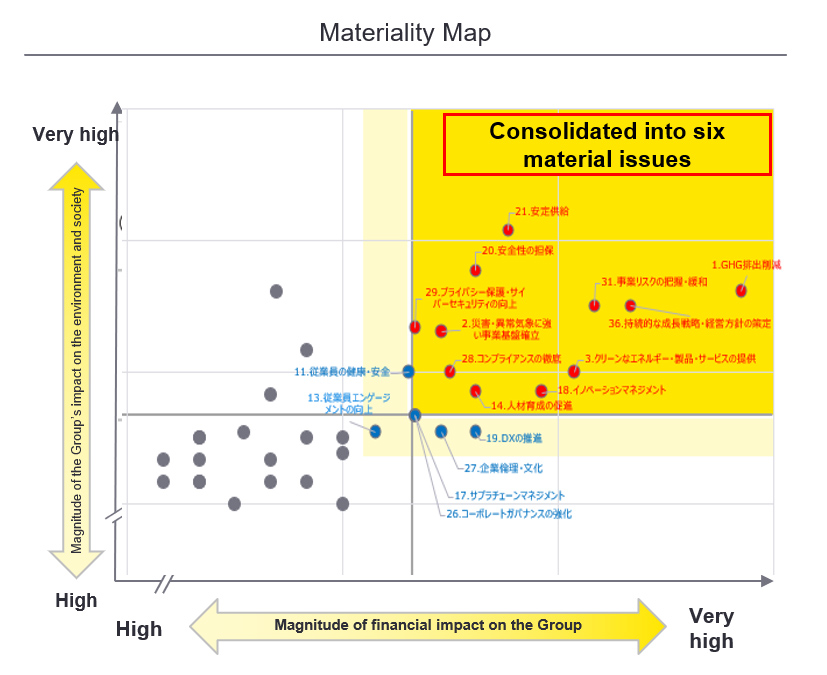
Materiality Map

Key challenges are identified by assessing each social issue along two axes: “the magnitude of the Group’s impact on the environment and society” and “the magnitude of the financial impact on the Group”

STEP 3 Evaluating validity

Check the appropriateness of the selected key challenges through consultations with external experts and deliberations among senior management, and make revisions as necessary

STEP 4 Finalizing and disclosing material issues

Finalize the material issues and disclose them clearly to internal and external stakeholders through various communication channels